Showing posts with label cherries. Show all posts

Wednesday, March 14, 2018

#SoilMatters: Spring Rootflush always precedes Budswell

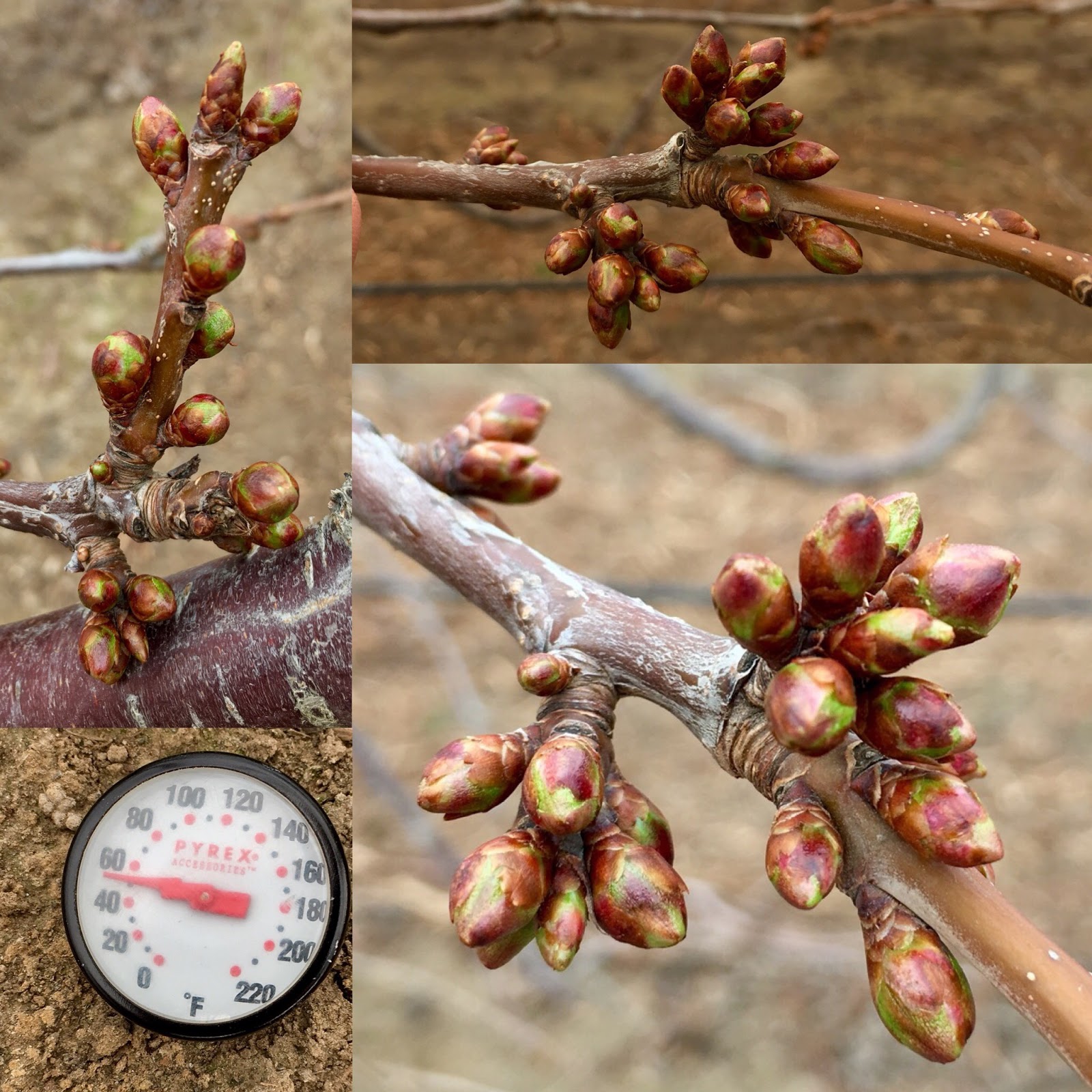
Photo credit: M. Suderman

Benton City, WA -
Soil temperatures have risen 4-6°F in the past week. This has signaled these Chelan cherry buds to swell. This is an early ripening variety. Which means the number of days a farmer has to grow and nurture the crop are limited. This means every day counts from bloom until harvest and are critical to develop the fruit in preparation of harvest. For instance, an early variety may have 70-80 days from Full Bloom (pollination) until harvest. A week of cooler than normal weather or delayed nutrient application, reduces the growing response window by 10%; a limiting factor, if you will. All early crops are vulnerable to the uncertain eastern Washington weather conditions; this can include cold temperatures, rain, hail, frost, etc. all of which can limit the amount AND quality of harvestable fruit to ship to stores.

Soil fertility applications can begin based on the plant development stage. Roots are foraging just like a grizzly bear awakening from hibernation...hungry, thirsty and ready the ‘grow’. A reminder that roots always grow two to three weeks ahead of budswell activity.

Last fall, many orchards were not fertilized as usual due to a late harvest (~3 weeks) and an early snow. All efforts were focused on getting fruit picked and into the packing house or C.A. storage. Basically, Postharvest fertility was cancelled and trees went into dormancy ‘hungry’. It’s like going to bed without supper. Dormant plants’ sole energy (food) source is stored carbohydrates. These are built via photosynthesis in the previous growing season. The photosynthates needed for the upcoming crop are above the energy requirements of the current crop and stored until needed. When trees are overly stressed during the growing season, it has a direct effect on the current crop quality AND next crop’s potential too.

If this happened in your orchard(s), you likely have a plant-energy deficit going into the bloom stage. An energy deficit at bloom can reduce the viability of blossoms, limit pollination activity, cause premature abortions, etc. Regardless of the cause, it costs on the bottom line of profitability. Trees are well aware of the “available energy” stored for use and self-regulate accordingly. This can be a major limiting factor in setting a crop versus a really good crop.

With a well planned fertility program in place, you can produce tonnage without sacrificing quality. In Neoteric Agriculture, utilizing “plant-ready” nutrients delivers a higher level of use efficiency for a more positive crop response.

Monday, May 16, 2016

Cherries - Spring Rains and Fruit Harvest


For fruit growers, harvest is their final exam. It is the “acid-test” of how well their plans and efforts paid off. To get close to harvest and not be able to pick due to crop failure is devastating. Avoiding that is a big challenge.
 
There are many details involved in producing cherries. While an early variety can be very lucrative, you only have about a 60 and 90 day timeframe to work within (depending on region and variety) to “make the magic” happen. Invariably there are weather events; sometimes rain and sometimes worse. These bring challenges to the potential yield, planning for them beforehand can be in your best interest. Let’s discuss pre-harvest rain.
First, let’s consider some common concepts and ideas:
Rain assumptions and facts:
Has an average pH of 5.4-5.6
Not necessarily. This tends to differ regionally, especially since there are less sulfur compounds, in the air, due to clean air restrictions, so check rainwater to confirm.
Assumed to be perfectly distilled water.
Not necessarily. In California, for instance, there is a good amount of sodium found in rainwater because of the close proximity to the Pacific Ocean; check to confirm.
A 1” rain event can add 15-20 lbs. of NO3-N per acre.
I have found this to be fairly accurate, but again, check your field to confirm. The key here is to offset the adverse nitrate effects to the fruit. When harvest is within 2-4 weeks, nitrate levels, in the fruit, should be very low. A nitrate application (planned or unplanned) shifts nutrient proportions out of balance and delays fruit maturation. Nutrient focus should be placed on K, Mg, Mn, Zn and a little P (all in “plant-ready” forms) to stimulate photosynthetic efficiency. The byproduct of photosynthesis is sugar (C6H12O6). Sugar is a carbon source. Carbon is needed ASAP to correct the imbalanced C:N ratio, due to the nitrogen influx, from the rain. The fastest way to get these into the plant and fruit is with a foliar nutrient spray. Check with your certified crop adviser for the best options available to you.
Irrigate the field to saturation prior to or during the rain event to lessen rainwater uptake.
The concept: a “full vessel” cannot and/or will not take absorb more fluid. Makes sense; right? Here are few details to keep in mind:
·         Turgor Pressure: Plants drink water. In fact, if supplied to them, they will “bloat up” on water.
·         At Preharvest Stage: Plant focus shifts to “finishing” the crop. That means the movement of liquid is already going into the fruit…adding more probably won’t help as much as you’d think.
·         Osmatic Gradient Differential:
o   The pressure difference between the rainwater “outside” and the (concentrated) sugar content “inside” the fruit tends to "pull" water into the fruit (dilution effect). This creates immense pressure on the skin (from within) and a high likelihood of cellular rupture.
o   Fruit damage: It turns a brown to black color, just like freeze damage. In a freeze event, the cells swell (due to ice expansion) and rupture...it's the same in a rain event. The cells expand beyond their capacity to “flex” and burst.
So what is needed, by the fruit, when it rains close to harvest? Cell Elasticity. Your cherries need to be strong enough to flex and bend. Larger, thicker, stronger (nutrient-rich) cells, fruit cell walls and leaves help cherries more readily manage the adverse effects of rain; because larger cells have more volume capacity and thicker cells are stronger and less permeable and therefore less prone to “stretch marks” or “growth cracks”.
Applications can be made prior to the rain and even immediately afterwards, but “spoon-feeding” nutrition while growing the crop is ideal. Your nutrient plan should include traces like copper, manganese, boron, in regular, small amounts. This will have your crop “front-loaded” before a rain (or weather) event takes place and will have positive benefit on next seasons fruit bud development. Ideally, traces should be included within the product formulation, because a “finished” product is more manageable and less likely to have elevated phytotoxic risk. The less ingredients added to a foliar spray mix, the less the risk of “new chemistry” (phytotoxicity) forming and becoming a problem in the field.
These are some things that have worked for me and while not an exhaustive list of cherry and weather issues, it does give you a starting point for discussion with your crop adviser. And as I mentioned earlier, seek their counsel for sound advice on plant nutrition treatment options.

Popular Posts

Previous Blog Posts

Sponsor

Navigation